
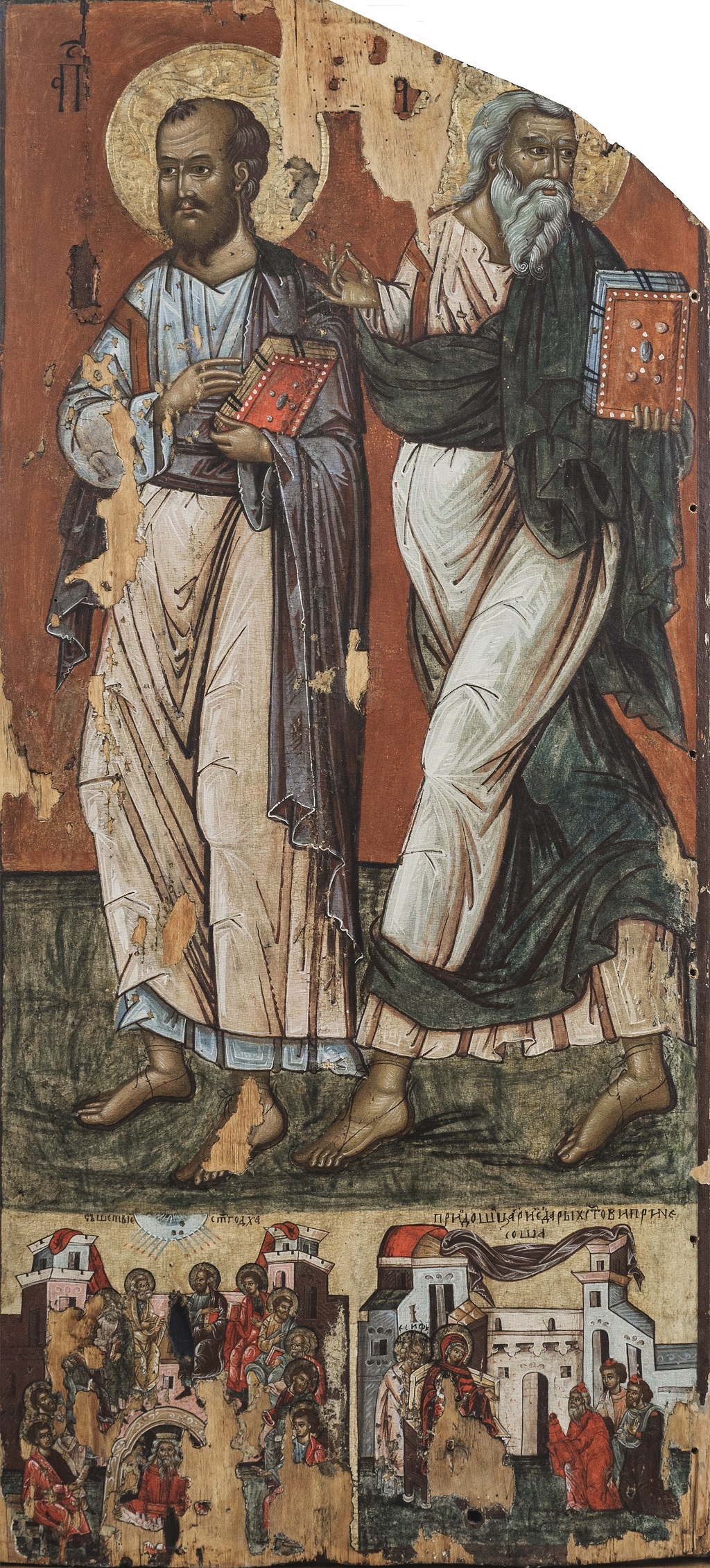
Name: icon "Paul the Apostle and Matthew the Evangelist; Pentecost and Adoration of the Magi"
Author: unknown
Date: mid 16th century
Country: Ukraine
Technique/material: tempera and silver gilt on panel
The icon is part of the iconostasis exhibited in the museum "Stara Skvaryava iconostasis of the XVI-XVIII centuries"
Description:
Apostle Paul is traditionally depicted with a book. Although he was not an evangelist, he is attributed with the authorship of most of the New Testament epistles, and, accordingly, his attribute is also the book. Another common attribute of Paul is a sword, but in Stara Skvaryava iconostasis, the apostle is depicted without it. Paul is also often portrayed with a dark, pointed beard, big sideburns, and short hair.
The Evangelist Matthew did not have such a well-established iconography as some other saints. Among his attributes, like all the evangelists, is the book, and his symbol is typically an angel (or a winged figure). However, he could be depicted as a young man with dark or dark-brown beard and hair, or as an older man with long gray beard and hair, as he is shown on the Stara Skvaryava icon.
The Descent of the Holy Spirit is one of the most important feasts in the liturgical calendar. It essentially commemorates the birth of the Church, which begins with the promised sending of the Holy Spirit by Jesus to the apostles. After this event, they dispersed throughout the world to preach the Gospel. In Eastern iconography, this event is depicted similarly to the icon from Stara Skvaryava: a semi-circle (or rows, or multiple rows) of apostles gathered beneath an open sky, from which twelve rays with flames (or flames themselves) descend upon them. The architectural background behind the apostles indicates that they are indoors, as suggested by the red cloth hanging behind them (thus, the iconography conveys an indoor setting). An interesting archaic element of the composition is the portrayal in the lower part of the icon of an elderly figure wearing a crown and holding a characteristic fabric (towel, cloth?) in their hands. Sometimes there is an inscription near the figure's head that identifies the depiction as 'Cosmos' (Universe). Researchers and theologians interpret such iconography to signify that the teachings the apostles will spread through the guidance of the Holy Spirit will extend throughout the entire world (Universe).
The icon “Adoration of the Magi” is not typically associated with the Feasts tier, and its subject matter is primarily related to the Nativity of Christ. It portrays the adoration of the three Magi, who were led to the Infant Jesus by the Star of Bethlehem. In Ukrainian iconography, there are instances where the Synaxis of the Most Holy Theotokos (a feast celebrated by the Eastern Church on the day after the Nativity of Christ) was depicted. In these icons, the Mother of God with the Child is depicted on a throne as a Queen, and earthly kings come to pay homage to her.
The description was prepared by Roman Zilinko, art historian, icon painter