
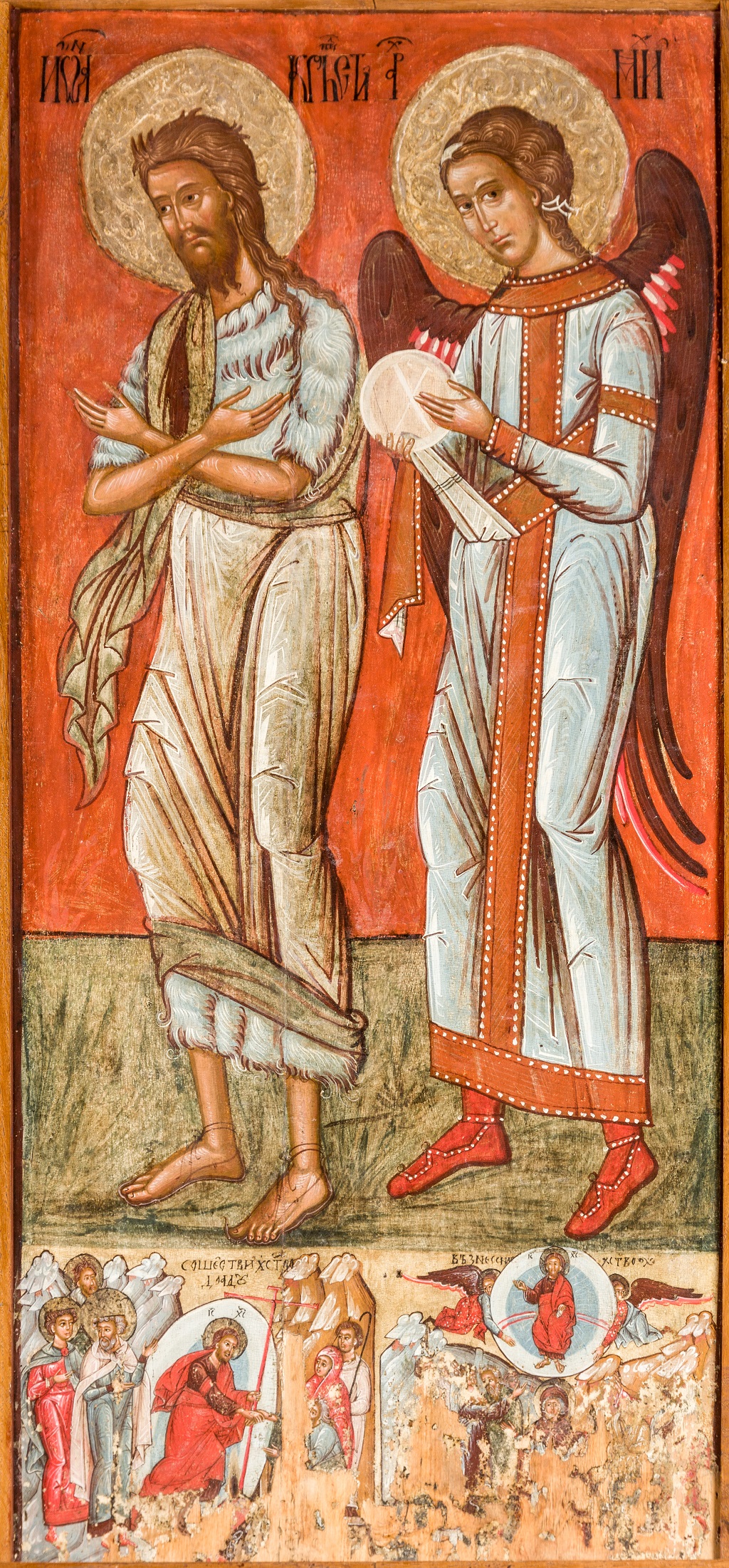
Name: icon "John the Baptist and Archangel Michael; Harrowing of Hell and Ascension of Jesus"
Author: unknown
Date: mid 16th century
Country: Ukraine
Technique/material: tempera and silver gilt on panel
The icon is part of the iconostasis exhibited in the museum "Stara Skvaryava iconostasis of the XVI-XVIII centuries"
Description:
Similar to the icon of the Virgin and Archangel Gabriel, this icon is also characterized by its static composition compared to other icons in the apostolic tier. The depiction of St. John the Baptist is traditional: he is portrayed as a hermit with long flowing hair and a beard, wearing a camel-hair garment covered by a brownish-golden chiton (a tunic). His hands are crossed on his chest, and his gaze is directed towards Christ at the center of the tier. Archangel Michael is depicted almost identically to Archangel Gabriel, except for the shade of his sticharion (tunic or robe), which has a slightly bluish tone. The archangel's gaze is directed toward the viewer.
The icon of the Harrowing of Hell belongs to the iconography of the Passion of Christ or the Resurrection cycle and represents an apocryphal subject that is not found in the canonical Gospels but is briefly mentioned in the apostolic letters. Instead, it appears in apocryphal texts, including the Gospel of Nicodemus. In these texts, it is described how, on the second day after his death, on Saturday, Jesus descended into Sheol, met and redeemed all the righteous figures of the Old Testament, and opened Heaven for them. On the icon itself, alongside the central image of Christ, you can see King Solomon and King David, John the Baptist, as well as Adam and Eve, to whom Jesus extends his hand.
Although the icon of the Ascension of the Lord in the Stara Skvaryava iconostasis is poorly preserved, it still follows a relatively traditional composition. At the top, on a cloud background raised by angels, Christ is shown seated on his throne. In the lower part of the composition, at the center, against a backdrop of hills, you can see a group of apostles and the Virgin Mary in the Orans position, which signifies a posture of prayer.
The description was prepared by Roman Zilinko, art historian, icon painter