
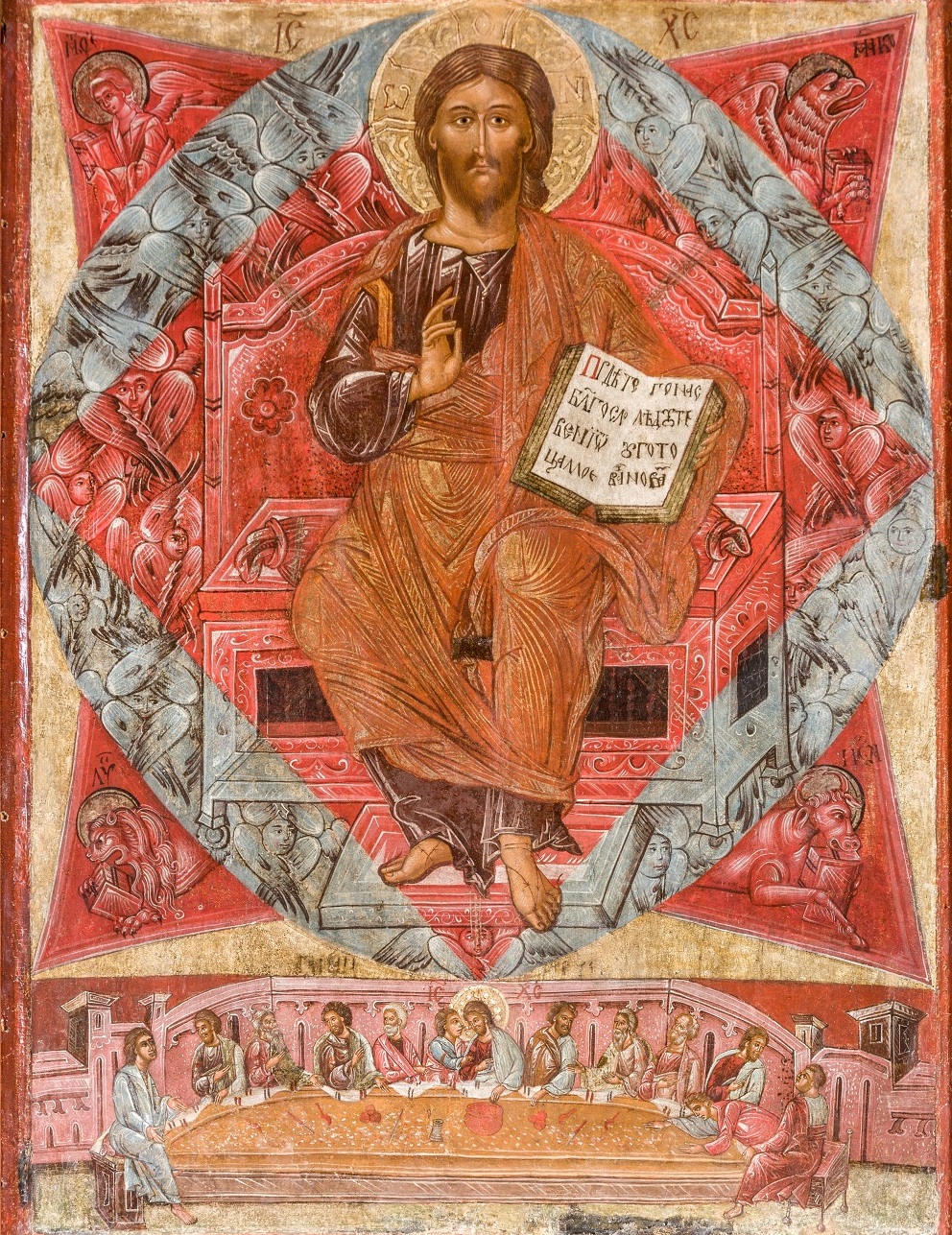
Name: icon "Christ in Majesty; Last Supper"
Author: unknown
Date: mid to late 16th century
Country: Ukraine
Technique/material: tempera and silver gilt on panel
The icon is part of the iconostasis exhibited in the museum "Stara Skvaryava iconostasis of the XVI-XVIII centuries"
Description:
Similar iconography began to develop as early as the first millennium AD but became more established in the early second millennium. It depicts Christ as a judge returning to Earth in glory to execute the Last Judgment. In this representation, Christ is portrayed in his full divine authority, surrounded by heavenly beings. He is seated on a throne, adorned in crimson and gold robes, with his gaze directed toward the viewer. His right hand is raised in a gesture of blessing, while his left hand holds the open Gospel with the text: “Come, you who are blessed by my Father, inherit the kingdom prepared for you from the foundation of the world” (Matthew 25:34). The figure of Jesus is framed within a red diamond shape, which is inscribed within a blue oval. Both the diamond and the oval are filled with monochromatic depictions of angelic beings. The oval is surrounded by three red triangular rays, each containing images of mythological winged creatures known as the tetramorph: an angel (a human figure with wings), an eagle, a lion, and a bull. For the first time, these beings are mentioned in the Bible in the prophecy of Ezekiel (Ezekiel 1:4-28). Later, in the Book of Revelation, they are described by John the Evangelist: "...around the throne were four living creatures, full of eyes in front and behind. The first living creature was like a lion, the second living creature like an ox, the third living creature had a face like a man, and the fourth living creature was like aa eagle in flight. Each of the four living creatures has six wings and was full of eyes all around and within. And day and night they never stop saying: “Holy, holy, holy, is the Lord God Almighty, who was and is and is to come!” (Revelation 4:6-8). In later Christian tradition, these beings became symbols of the Evangelists. However, the interpretation of which being corresponded to which Evangelist varied. The most common version associates the lion with the Evangelist Mark, the eagle with John, the man with Matthew, and the ox with Luke. Interestingly, in the Stara Skvaryava iconostasis, the interpretation differs: the man is associated with Matthew, the eagle with Mark, the lion with Luke, and the ox with John.
As mentioned earlier, the icon of the Last Supper was not commonly included in iconostases until the mid-16th century, and it was usually found in icons related to the Passion of the Christ. In the Stara Skvaryava iconostasis, we have one of the earliest instances of the Last Supper being included in an iconostasis, and it is placed in the central tier. The iconography here differs from the traditional Byzantine style. In older compositions, Christ was often depicted at the edge of the table, with the apostles sometimes semi-reclining behind it, following the Greek tradition, rather than sitting on chairs or benches, as was customary in the Middle Ages. In this iconostasis, Christ is seated at the center of the table, surrounded by the apostles. Next to him, you can identify the John the Apostle, who, as the Gospels mention, was sitting beside him. Judas can be recognized by his posture as he leans toward the table. When Christ's disciples asked him who would betray him, he responded, "It is one of the twelve who is dipping bread into the bowl with me" (Mark 14:20).
The description was prepared by Roman Zilinko, art historian, icon painter