
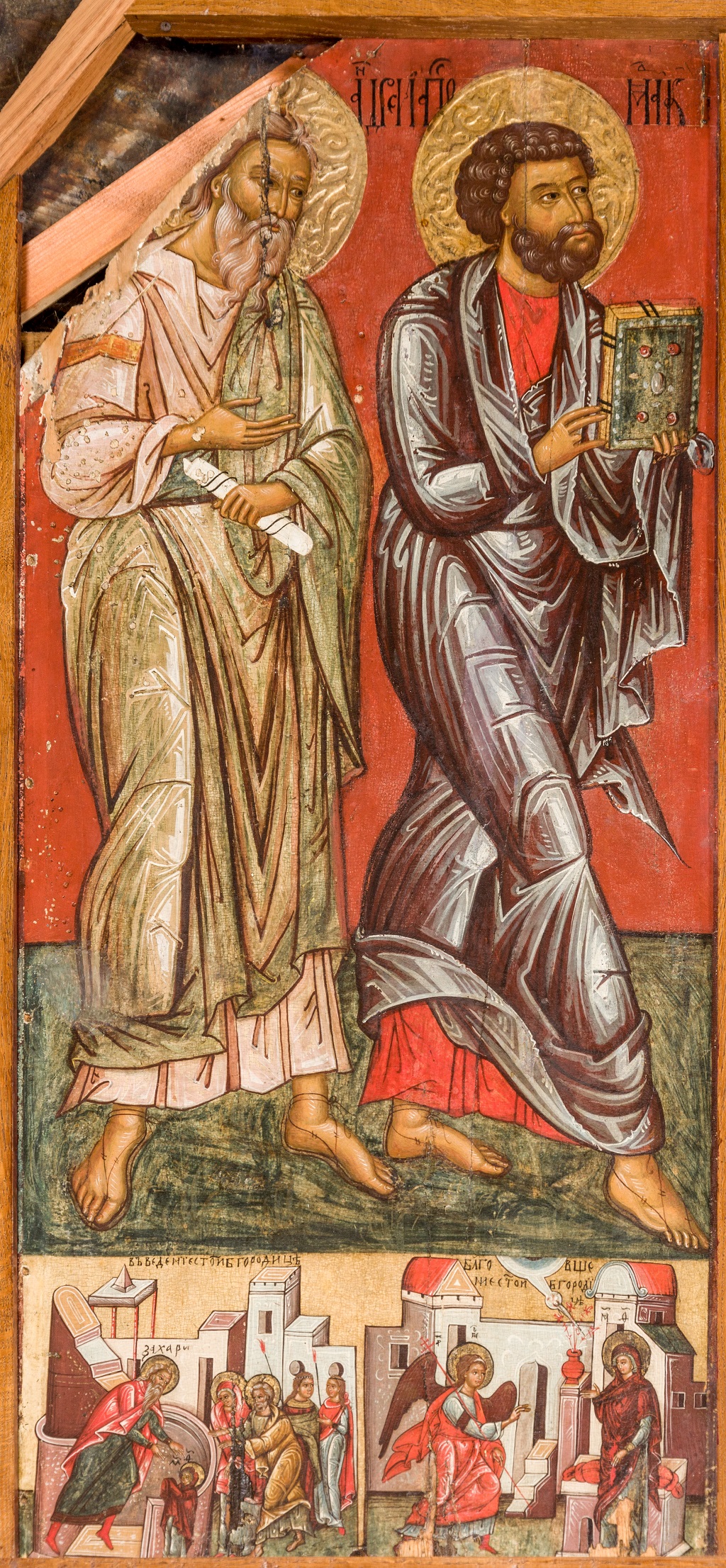
Name: icon "Andrew the Apostle and Mark the Evangelist; Presentation of Mary and Annunciation"
Author: unknown
Date: mid 16th century
Country: Ukraine
Technique/material: tempera and silver gilt on panel
The icon is part of the iconostasis exhibited in the museum "Stara Skvaryava iconostasis of the XVI-XVIII centuries"
Description:
Currently, the icon is on the far left side of the tier. The upper left corner of the icon has been cut, likely during one of the stages of reconstructing the iconostasis to fit it under the sail that supports the octagonal drum of the dome.
It's worth noting the iconography of the apostles Andrew and Mark. Although icon painters often depicted the apostles in a somewhat stylized manner, they still had characteristic individual features and details by which they could be identified apart from inscriptions. Andrew was typically depicted with a long beard and wavy, flowing hair. The hair color varied, and in the icon from Stara Skvaryava, he is portrayed with gray hair. In his hand, he holds a scroll, which is a common attribute of the apostles. Only the evangelists and Saint Paul were typically shown holding books. Saint Mark was traditionally depicted with short, dark, curly hair and a beard. Like the evangelist, he is depicted with a book.
All the feasts in the Stara Skvaryava iconostasis are impressive in terms of their craftsmanship and dynamic composition. The first feast in the tier, “The Presentation of the Virgin”, illustrates the moment when the little Mary was given to the Jerusalem Temple for upbringing. This event is not found in the Gospels but originates from apocryphal texts (i.e., texts that existed in the Church tradition but were not recognized as original canonical texts). As we know from these sources, Mary's parents, Joachim and Anna, were of an older age and were not able to have children, so the birth of Mary was perceived as a miracle, for which they promised to dedicate their daughter at an early age to be raised in the Temple. The Church celebrates this event as a major feast, and it has a rich iconography in Christian art. In contrast, the mention of the Annunciation is found in the Gospels (specifically, in the Gospel of Luke), and the event is particularly revered in Christianity. From the moment Mary learns that she will give birth to the Messiah, the story of redemption and the salvation of humanity begins. Therefore, the Annunciation also has a rich iconography in world art.
The description was prepared by Roman Zilinko, art historian, icon painter