
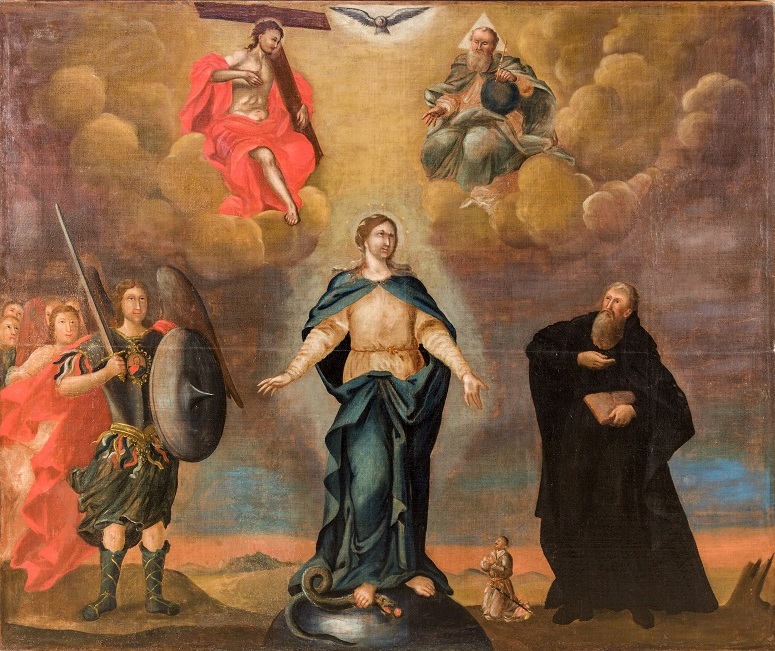
Name: icon "Immaculate Conception of the Virgin Mary with the Holy Trinity, the Synaxis of Archangel Michael, an unknown saint, and a portrait of the founder"
Author: unknown
Date: mid-18th century
Country: Ukraine
Technique/material: oil on canvas
The icon is exhibited in the museum "Stara Skvaryava iconostasis of the XVI-XVIII centuries"
Description:
Icon from the late 18th century represents the idea and teaching of the Immaculate Conception of the Virgin Mary. This concept originated in the Eastern Church in the first millennium after Christ but gained particular prominence in the Western Catholic Church. The earliest depictions of the Immaculate Conception of the Virgin Mary, where she stands on a terrestrial globe, her foot resting on a serpent, and a crown of twelve stars around her head, likely appeared in the 15th century and became more popular in the following century.
In any case, this iconography has a clear Western origin and was present in Ukrainian art after the adoption of the Union of Brest in 1596. It became more widespread in the 18th century as Latin practices and cults began to influence the Eastern rite of the Ukrainian Church.
The unique feature of the Stara Skvaryava icon is the combination of this image with the Synaxis of the Archangel Michael and a small figure depicted in prayer posture next to an unknown saint (presumably the heavenly patron of the latter). The presence of the Synaxis of the Archangel Michael suggests that the icon was created for the Stara Skvaryava Church dedicated to him. The identity of the saint and the small figure in prayer on the opposite side of the icon is mysterious. This way the founder or ktitor of the church was traditionally portrayed. As his name is not mentioned on the icon, his identification is complex. The image of the saint does not provide enough information to identify the name of the founder of the church. The icon portrays an elderly figure with a gray beard, dressed in black monastic attire and holding a book. Therefore, it is likely a representation of a holy monk, but no further clues are provided. The final attribution of the icon remains pending.
The description was prepared by Roman Zilinko, art historian, icon painter