
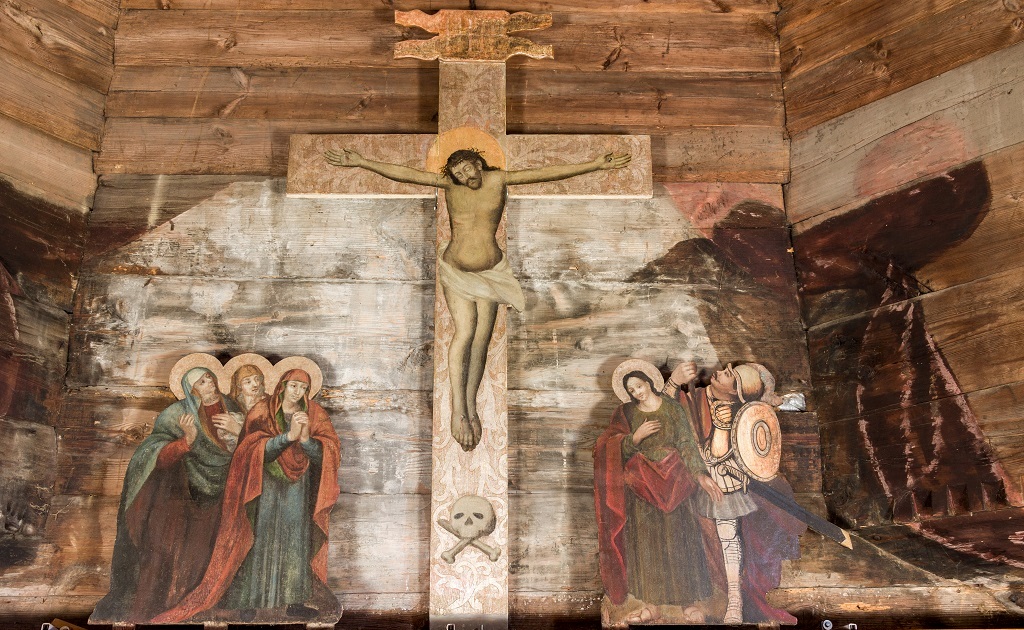
Name: Crucifixion with Attendants
Author: unknown
Date: mid-18th century
Country: Ukraine
Technique/material: tempera and silver gilt on panel
The crucifixion is part of the iconostasis exhibited in the museum "Stara Skvaryava iconostasis of the XVI-XVIII centuries"
Description:
The tradition of crowning the iconostasis with a Crucifixion scene probably has ancient origins, although there is limited material to confirm this. Nevertheless, this type of completion appears logical, and there are some preserved analogies in the medieval art of the Western Church, where the Crucifixion was placed above the balustrade under the arch of the sanctuary (approximately where the Eastern Church had an Iconostasis).
The oldest Ukrainian icons of the Crucifixion that could have been placed at the top of the iconostasis date back to the 15th century. These icons were typically painted on a solid board and featured the Crucifixion of Christ and accompanying figures. The figures surrounding the Crucifixion often included the Apostle John, sometimes Centurion Longinus, and on the opposite side, the Virgin Mary, along with other holy women (Mary Magdalene, Mary the mother of James, Salome, etc.). These rectangular icons were placed at the top of the iconostasis and were attached to the wall that separated the sanctuary from the nave. In later times, likely from the beginning of the 16th century, such a wall was increasingly not made solid but had an arch-like opening into the sanctuary. This is when the completion of the iconostasis at the top with a cut-out board took hold. Since then, many similar compositions have emerged.
In the Stara Skvaryava iconostasis from the mid-16th century, the Crucifixion icon was created in an older tradition on a solid board (currently housed in the Andrey Sheptytsky National Museum of Lviv). However, for some reason, it was replaced with a composition in the mid-18th century, which can be seen there now.
At the center of the composition is the Crucifixion. The background of the cross is richly adorned with carved ornamentation. Above the cross, there is a characteristic tablet with the acronym of the inscription that, according to Pontius Pilate’s orders, was placed on Jesus’ cross – “IНЦІ” (Jesus of Nazareth, King of the Jews). The tablet itself ends with split ends on the sides.
Beneath the figure of the Crucified, there is an image of a skull with bones. The placement of the skull on the Crucifixion can be interpreted in various ways. In Aramaic, the name of the Golgotha hill where Jesus was crucified translates to “skull”. According to one legend, Adam was buried there, and the skull on the Crucifixion represents Adam’s skull. Another explanation for the name could be related to executions, where skulls and bones were commonly found. The Crucifixion from the Stara Skvaryava iconostasis strongly resembles the Crucifixion from the Zhovkva iconostasis (1697-1699) by Ivan Rutkovych, sharing similar ornamentation of the cross, tablet shape, the depiction of the Crucified Jesus, and more. This suggests a significant influence of the artist and his works on subsequent generations of Zhovkva craftsmen.
On either side of the Crucifixion, there are two groups of figures. To the left, there are standing women, and to the right, there are St. Apostle and Evangelist John and Centurion Longinus. There is no fixed iconographic canon for the number and identity of the women depicted in this scene. In some examples, only the Virgin Mary is shown, sometimes with Mary Magdalene, and in expanded versions, additional women may be present, totaling three to five individuals. On the opposite side, the Apostle John is always depicted since he, like the Virgin Mary, is explicitly mentioned by the evangelists. Sometimes, Longinus, the Centurion who oversaw Jesus’ crucifixion, pierced His side with a spear, and later converted to Christianity, is also included.
The description was prepared by Roman Zilinko, art historian, icon painter