
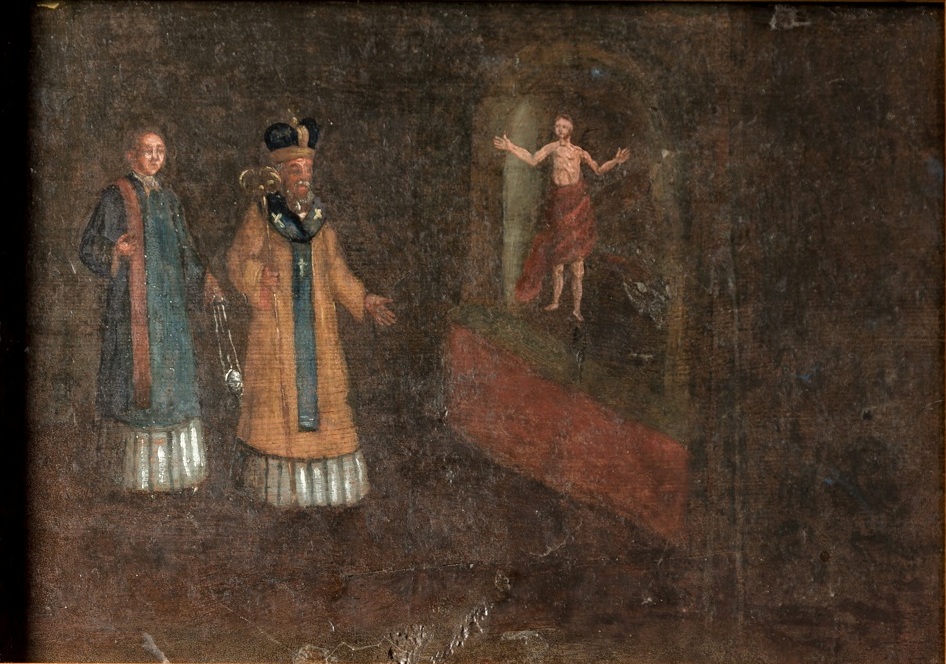
Name: icon "Appearance of Christ to Peter of Alexandria"
Author: unknown
Date: beginning of the 19th century
Country: Ukraine
Technique/material: oil on panel
The icon is part of the iconostasis exhibited in the museum "Stara Skvaryava iconostasis of the XVI-XVIII centuries"
Description:
This scene depicted on the icon is unique in the series as it is not based on the Gospel texts. Instead, it relates to the life of one of the Fathers of the Church, Peter of Alexandria. Since the last Sunday before Pentecost is dedicated to the Fathers of the First Ecumenical Council of Nicaea (325 AD), the icon is likely associated with this event. In some instances of iconography, the First Ecumenical Council was depicted as a solemn gathering of bishops, led by the Emperor. However, in Ukrainian iconography, the scene of the Appearance of Christ to Peter of Alexandria became more common to represent this event. The First Ecumenical Council is particularly known for condemning the teachings of Arius, a priest from Alexandria, who denied the existence of the Holy Trinity and believed that Jesus was a created being. Archbishop Peter of Alexandria was a key opponent of Arius. To prove the error of Arius, Peter referred to his revelation when Jesus appeared to him on the episcopal throne at the age of twelve. In this vision, young Jesus was partially unclothed, and when Peter asked who had torn his clothes, Jesus replied that it was Arius, who was tearing apart the Trinity. This revelation is what's depicted on the icon: in the center, Saint Peter, dressed as a bishop, stands, and next to him is a deacon holding a censer. On the right side of the composition, above the throne canopy (ciborium), stands a half-naked young Jesus with His hands raised.
This iconography of the Appearance of Christ to Peter of Alexandria became prevalent in Ukrainian art primarily through engravings found in liturgical books published in Ukraine.
The description was prepared by Roman Zilinko, art historian, icon painter