
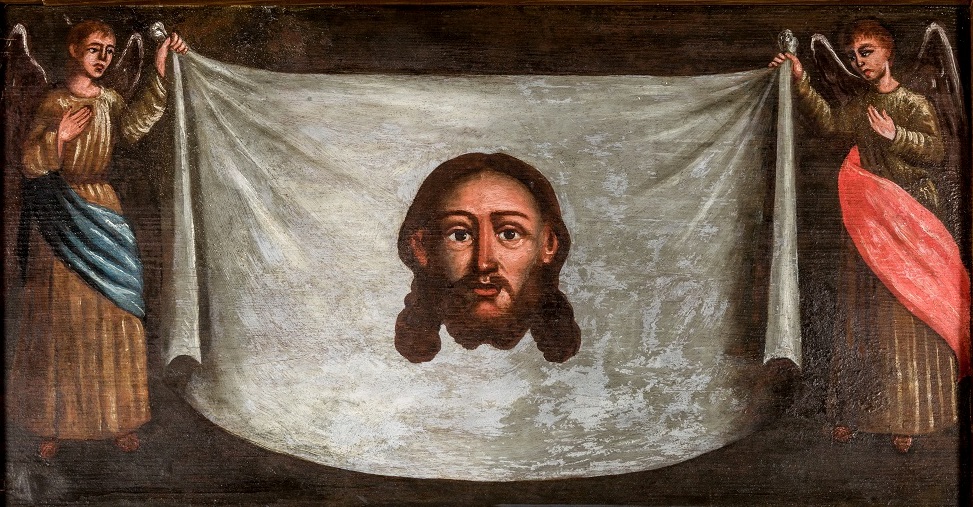
ame: icon "Image of Edessa"
Author: unknown
Date: beginning of the 19th century
Country: Ukraine
Technique/material: oil on panel
The icon is part of the iconostasis exhibited in the museum "Stara Skvaryava iconostasis of the XVI-XVIII centuries"
Description:
In earlier iconostases, the icon of the Image of Edessa or Icon Not Made By Hand was primarily placed in the centre of the Feast Tier, above the Beautiful Gate. However, starting from the second half and the end of the 16th century, and especially from the beginning of the 17th century, it was replaced by the icon of the Last Supper. Nevertheless, when the tier of Sundays of Pentecost appeared in the iconostases of Lviv and Zhovkva masters in the mid-17th century, the icon of the Image of Edessa took its place in the centre of this tier. In the Stara Skvaryava iconostasis, the icon is positioned to the right, above the Beautiful Gates, as the Feast tier and the tier of Sundays of Pentecost are not symmetrical.
The iconography of the Image of Edessa has its origins in the legend of Abgar, the ruler of Edessa, who was said to have lived during the time of Jesus. Abgar was gravely ill and had heard of the miracles performed by Jesus, so he sent his servant with a letter to Jesus, requesting healing. In one version of the legend, Jesus met the servant and, in response to the request, wiped his face with a cloth. His image was miraculously transferred to the cloth. When the servant returned to Edessa, Abgar was healed upon seeing the image. From that time on, this non-made image was revered as a great holy relic. In Christianity, it was considered the “icon of icons” because not only was it a true representation of Christ, but it also testified to his incarnation and coming to Earth. This was the reason for placing the icon above the Beautiful Gate in Ukrainian iconostases, where the faithful could not only meet and receive the body and blood of Jesus in the Eucharist through the doors but also contemplate his true image.
In the icon from Stara Skvaryava, we see the traditional iconography: a white cloth with the image of the Saviour’s face and two angels supporting the cloth.
The description was prepared by Roman Zilinko, art historian, icon painter