
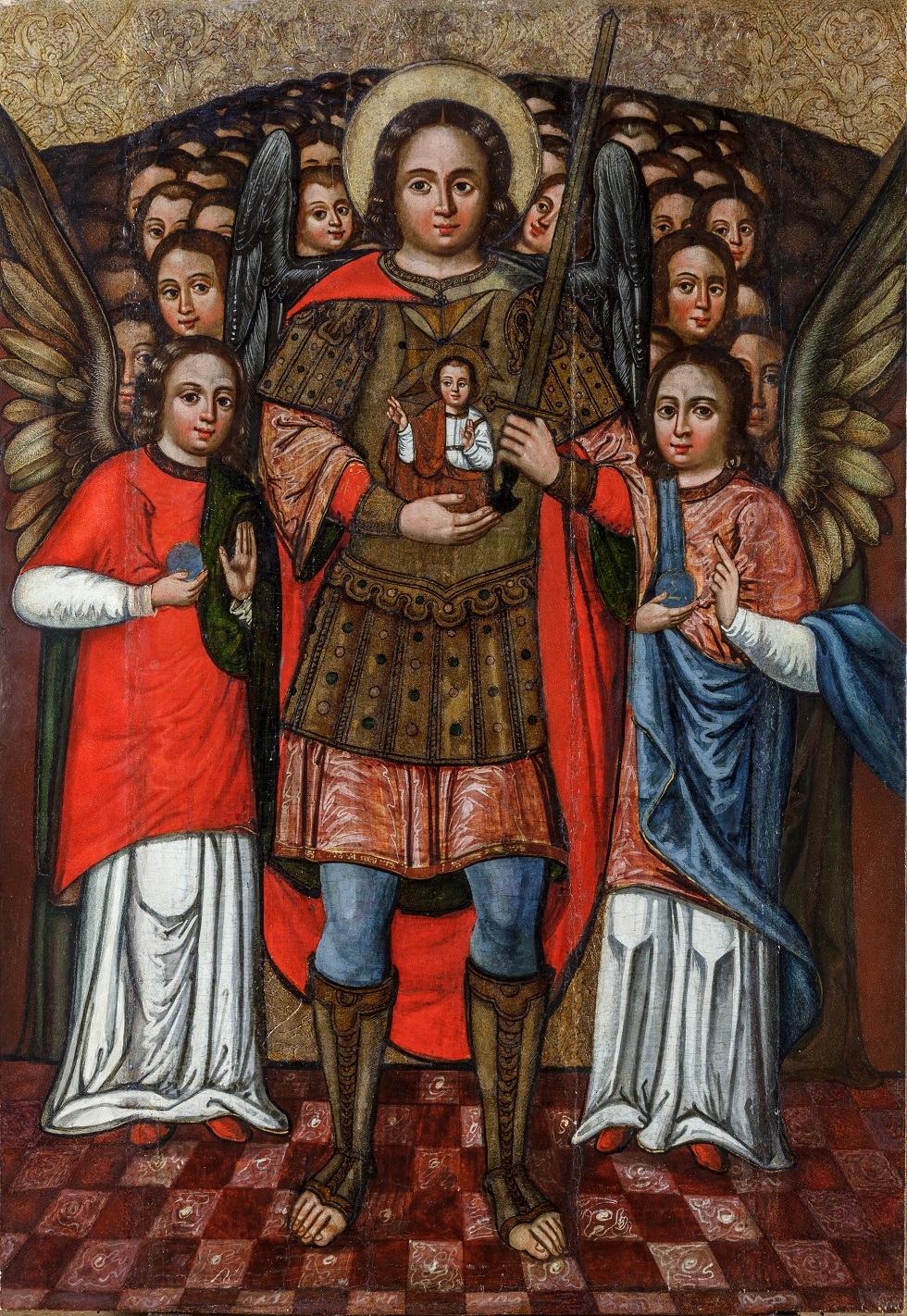
Name: Icon “The Synaxis of Archangel Michael”
Author: Ivan Rutkovych (?)
Date: 1685-87
Country: Ukraine
Technique/material: tempera and silver gilt on panel
The icon is part of the iconostasis exhibited in the museum "Stara Skvaryava iconostasis of the XVI-XVIII centuries"
Description:
This is the icon of the church’s patron and protector. The iconography of the icon corresponds to the meaning of the feast, which is the glorification of the angelic heavenly hosts led by Archangel Michael, who is traditionally depicted in the centre, surrounded by a large number of angels. In the icon from Stara Skvaryava, Archangel Michael is depicted in military attire (almost identical to his image on the Deacon’s Doors of the iconostasis). He upholds Emmanuel the Saviour with his right hand and carries a sword in his left. The depiction of Emmanuel in the centre of the composition emphasizes its significance – the angels are gathered around the Lord, ready to fulfil his will, especially considering the meaning of the name Emmanuel (God with us). More prominently than other figures, Michael is surrounded by images of angels: two angels in full height on either side of the Archangel, and behind them, ranks and heads of angels barely visible, creating the impression of an innumerable multitude. Interestingly, the angels are depicted standing on a tiled floor. Such depiction is characteristic of the Lviv and Zhovkva painting centres of the mid to late 17th century. The original image is preserved in the central part of the icon, and two outer boards were added after conservation (reconstruction was carried out by museum conservator Mariya Bonkovska).
Another feature of the iconostasis is that the icon of patron saint of church is placed in a separate altar, distinct from the main iconostasis structure. This was likely done in the second half of the 18th century when certain Latin liturgical practices were introduced into the Uniate Church, and side altars were added where additional liturgies could be celebrated when needed. The altar itself is adorned with columns and painted to imitate two types of marble – pink and blue. The icon is set within a deep, intricately carved double openwork frame, and the profiled cornice is decorated with carved and silvered garlands. The altar is completed with a carved cartouche depicting the Nativity scene. The cartouche was created simultaneously with the altar, and it can also be dated to the second half of the 18th century.
The iconography of the Nativity icon has Western origins and presents us with the scene of the shepherds’ adoration of the newborn Jesus. Similar iconographic analogies can be found in both Western European and local graphics.
The description was prepared by Roman Zilinko, art historian, icon painter