
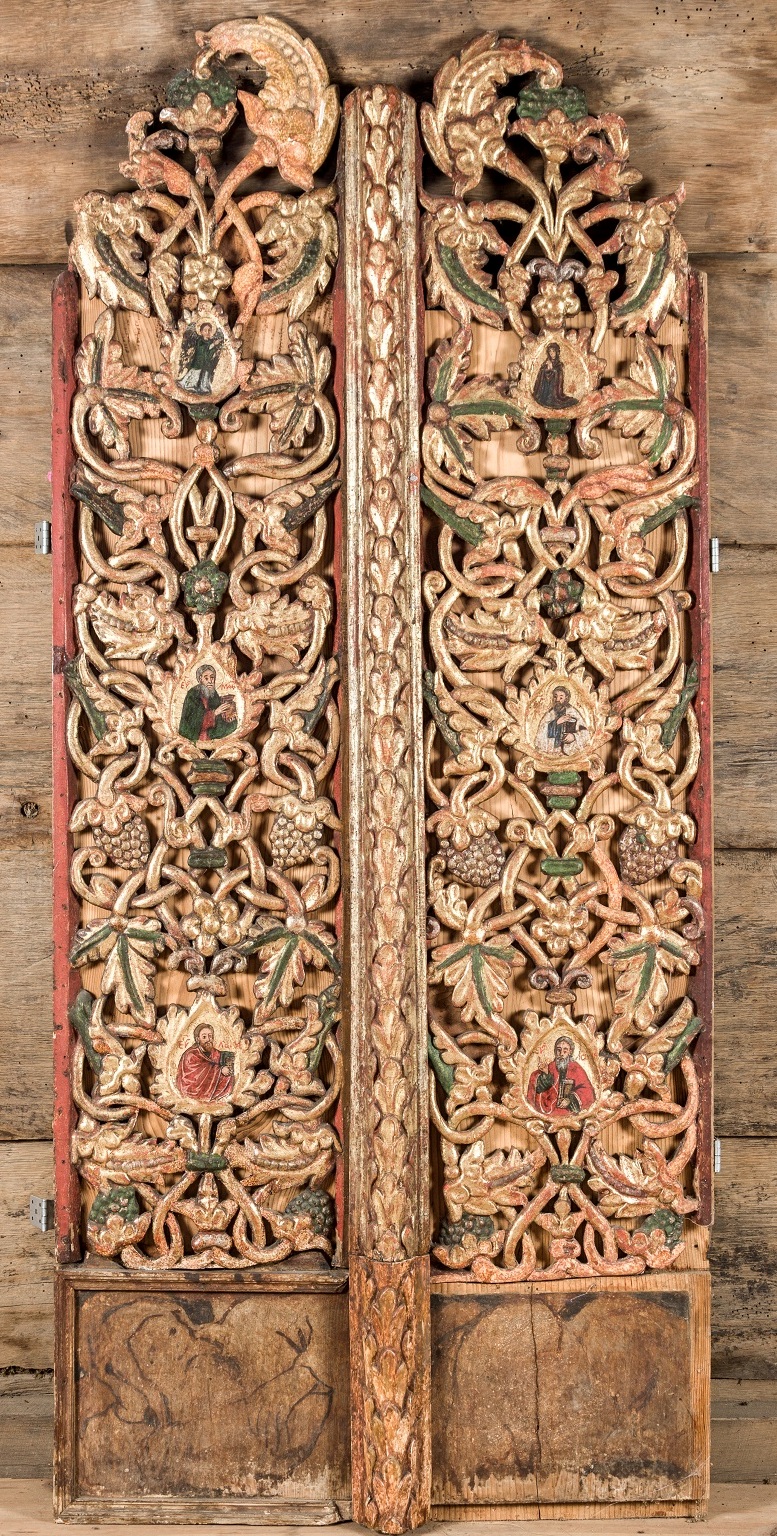
Name: The Beautiful Gate and portal
Author: Ivan Rutkovych (?)
Date: portal - 1645; the Beautiful Gate - second half of the 17th century
Country: Ukraine
Technique/material: tempera and silver gilt on panel
Description:
As mentioned earlier, the iconostasis of Stara Skvaryava was created by various craftsmen over several centuries. Parts of the Sovereign tier also come from different periods, although most of its icons can, with greater or lesser probability, be attributed to the heritage of Ivan Rutkovych and the masters of his circle, dating within the range of 1677-1687.
However, the Beautiful Gate and their portal stand out. Above the portal of the Beautiful Gate, there is a traditional inscription often placed in this location: “Theseare the doors of the Lord through which the righteous may enter” (this is a modern interpretation of the inscription’s meaning), followed by the date - 1645. The stylistic features of the figures depicted on the door frame correspond to this date. However, the doors themselves and the frescoes on them differ stylistically from the door frame and appear to be executed at a slightly later date. The upper carved part of the doors can be dated approximately to the 1660s-1670s, while the lower part, which features a barely visible figure of Jesse (the father of King David), can be dated to the late 17th century. In other words, even in the case of the Beautiful Gate and the portal, we have elements from different time periods assembled and incorporated together.
Traditionally, Ukrainian iconostases featured the four Evangelists and the scene of the Annunciation on the Beautiful Gates. Such depictions can be found in the carved panels of the doors of the iconostasis in Stara Skvaryava. Sometimes, the doors depicted John Chrysostom and Basil the Great, the creators of the Divine Liturgy, but only a few examples of this exist in Ukrainian art. However, starting in the early 17th century when changes in the architecture of Ukrainian iconostases occurred, incorporating carved framing for icons, the door were set within deep portals adorned with gilded profiles and cornices. At this time, the inner side of these portals began to depict the figures of saints or angels. Most often, Saints John Chrysostom and Basil the Great were painted here. In the Stara Skvaryava iconostasis, in addition to these saints, Saint Gregory the Theologian and Saint Stephen, the first martyr and deacon, are also depicted. In the arch of the portal, within a cloud, the blessing engagement of the Saviour Emmanuel is depicted (this is the name given in iconography to the image of Jesus Christ as a child). On both sides of him are seraphim and archangels Michael and Gabriel (interestingly, the latter is also depicted with a sword).
From the late 16th century, and particularly in the early 17th century, carving began to play an increasingly significant role in the decoration of the Beautiful Gates. Painted icons of the Evangelists and the Annunciation were placed within decorative cartouches framed by carving. Initially, this carving was flat and openwork, but over time it acquired more elaborate forms and depth. The ornamentation of the carving itself followed the aesthetics of prevalent European styles of the time, including the Renaissance, Mannerism, Baroque, Rococo, and so on. In the Beautiful Gate of the Stara Skvaryava iconostasis, the carving corresponds to Mannerist patterns, with the main ornamental motif being intertwined grapevines with clusters of grapes and grape leaves.
The description was prepared by Roman Zilinko, art historian, icon painter