
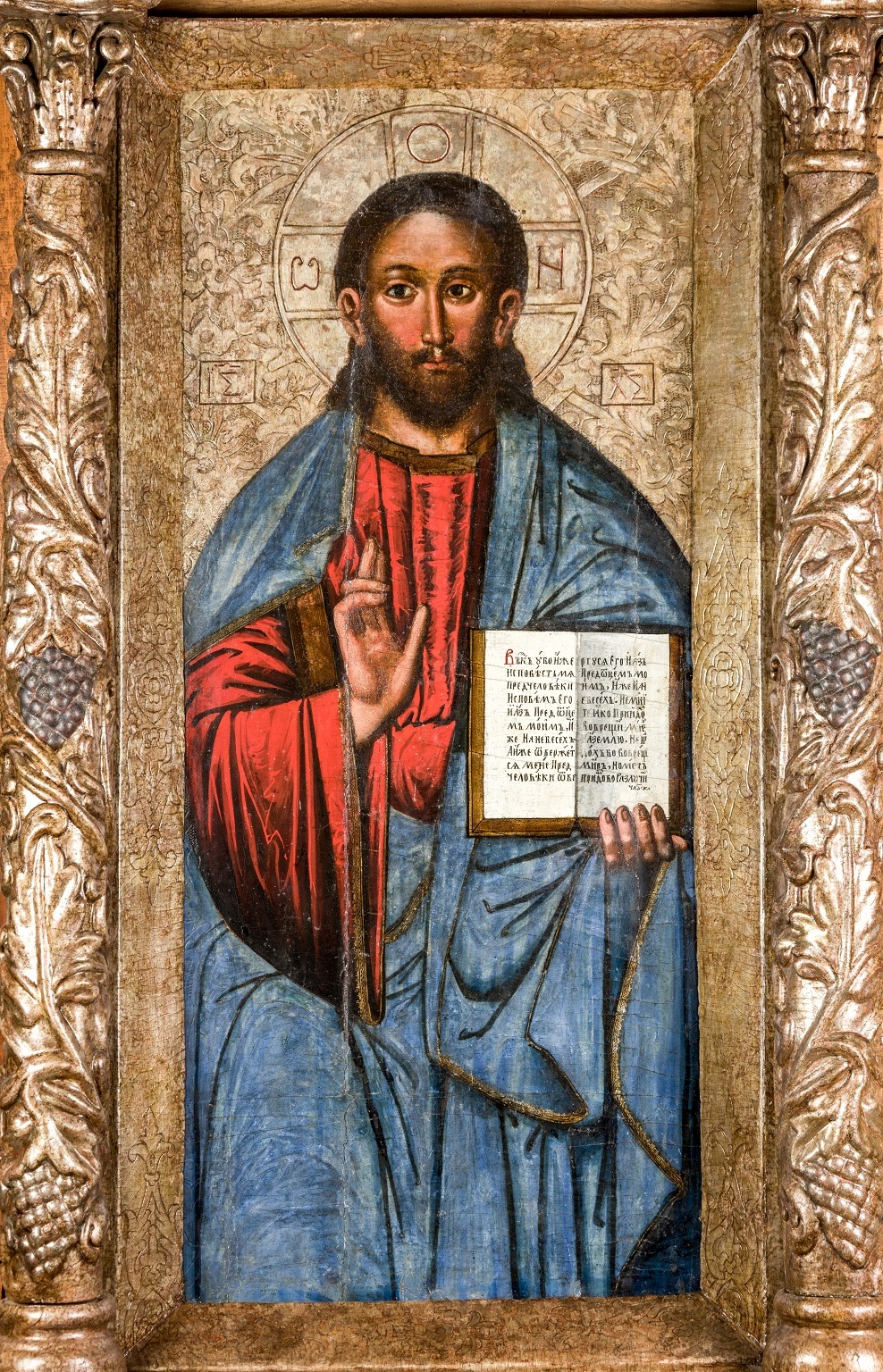
Name: icon of the Saviour
Author: Ivan Rutkovych (?)
Date: 1685 (?)
Country: Ukraine
Technique/material: tempera and silver gilt on panel
The icon is part of the iconostasis exhibited in the museum "Stara Skvaryava iconostasis of the XVI-XVIII centuries"
Description:
While researchers tend to agree on the iconography of icons of the Mother of God in the Sovereign tier of iconostasis of Ukrainian churches, often depicting the Hodegetria type with prophets in the fields around the icon, there is more ambiguity when it comes to the icon of Jesus Christ. The reason for this uncertainty lies in the limited number of preserved icons of Christ , which exist in various iconographic variations. There are icons of the Saviour in full stature (sometimes with half-length figures of the Virgin Mary and John the Baptist on either side of Christ’s halo), icons of the Saviour in half-length with the apostles depicted in the fields around him, icons of Christ Pantokrator (seated on a throne), icons of Christ in Glory (surrounded by angels and symbols of the Evangelists), and other isolated iconographic variations of Jesus Christ.
As a result, it remains an open question how the paired icon to the Mother of God in the iconostasis might have looked. It is possible that different variations existed, and in some cases, there might not have been a paired icon to the Mother of God. Instead, the paired icon might have been a representation of the church’s patron saint or the saint to whom the church was dedicated.
In any case, from the beginning of the 17th century, Ukrainian iconostases predominantly feature the iconography of Jesus Christ depicted in a half-length form, precisely as presented in the iconostasis from Stara Skvaryava: Christ in a crimson chiton, over which is a blue himation, a garment adorned with a golden border. His right hand is raised in blessing, while his left hand holds an open Holy Scripture with the text from the Gospel of Matthew (10:32-34). The face of Christ is depicted in a clear frontal view, and a characteristic feature of the time is the prominently emphasized ears, which is typical of 17th-century iconography. Above Christ’s head is a cruciform halo with inscribed letters Ο WΝ, which translates from Greek as one of the names of God – “The Existing One, He Who Is”. On the carved, ornamented, silvered background imitating gold in rectangular compartments, letters from Christ’s monogram are arranged: ΙΣ ΧΣ.
This is a typical iconography for that time, which may differ only in details such as the positioning of Jesus’ blessing right hand, the arrangement of the fingers on the hand, and whether the left hand holds an open or closed book, and if open, which part of the Holy Scripture is depicted.
The description was prepared by Roman Zilinko, art historian, icon painter