
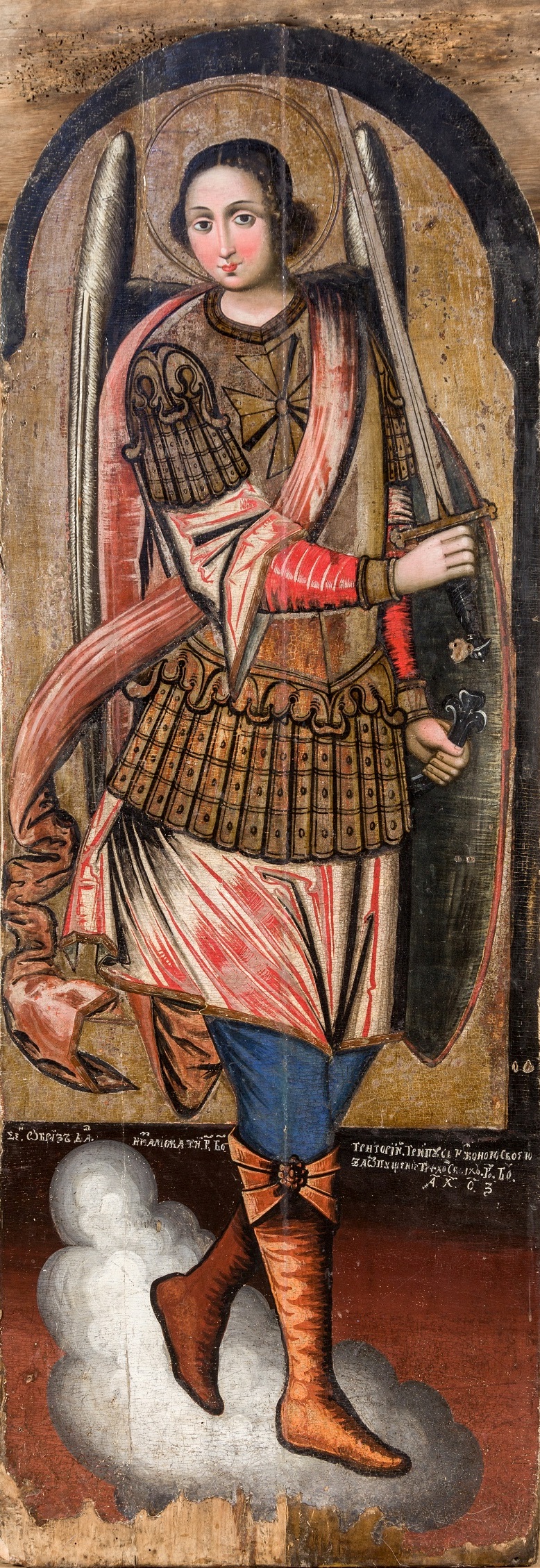
Name: Deacon’s Door with Archangel Michael
Author: Ivan Rutkovych (?)
Date: 1677
Country: Ukraine
Technique/material: tempera and silver gilt on panel
The Deacon's Door is part of the iconostasis exhibited in the museum "Stara Skvaryava iconostasis of the XVI-XVIII centuries"
Description:
The presence of Deacon’s Doors in the iconostasis is rooted in liturgical tradition. The central feature of the iconostases is the Beautiful Gate, located at the centre of iconostasis, through which the priest enters from the sanctuary to the faithful during the liturgy. On the other hand, Deacon’s Doors serve both the priest during the Great Entrance procession in the Liturgy and for use by the deacons and attendants, hence their name. The so-called “Northern Deacon’s Doors" (located to the left of the Beautiful Gate) are typically considered obligatory. The oldest pre-altar partitions originally featured only one set of Deacon’s Doors (this archaic tradition is preserved in the iconostasis from Stara Skvaryava). The second set of Deacon’s Doors in an iconostasis appeared later. Since they do not have a defined liturgical function, their appearance was likely driven by a desire to create symmetry in the iconostasis’s Sovereign tier.
It is difficult to say what the earliest Deacon’s Doors looked like. They were likely just openings in the partition covered with textiles, embroidery, or paintings. The earliest surviving Deacon’s Doors date back to the early 17th century, and they were solid planks with depictions of saints or archangels. The lack of uniformity in the figurative representations on Deacon’s Doors supports the hypothesis that these representations are from a later tradition. Different saints, such as deacons Stephen and Lawrence, Old Testament high priests Aaron and Melchizedek, and archangels Michael and Gabriel, were depicted on these doors.
On the Deacon’s Door from Stara Skvaryava, Archangel Michael is depicted in full growth. The Archangel stands on a cloud, frozen in motion directed towards the centre of the iconostasis. His torso is in semi-profile, facing the viewer. In his right hand, he holds a sword, while his left hand carries a large oval shield. Archangel is dressed in attire typical of the Baroque era: a breastplate with a cross, high boots, blue trousers, a pink tunic, and a scarf of the same colour draped over his left shoulder, forming intricate folds. The angel is depicted with an uncovered head, without a helmet, and there is a halo around his head. Folded wings are visible behind his shoulders. The background of the icon is silvered, tinted to appear golden, and the ground is reddish-brown. On the ground, there is a foundational inscription that tells us that the icon was created in 1677, commissioned by Gryhorii Grypus with his wife. Unfortunately, the artist did not leave his signature.
The description was prepared by Roman Zilinko, art historian, icon painter