
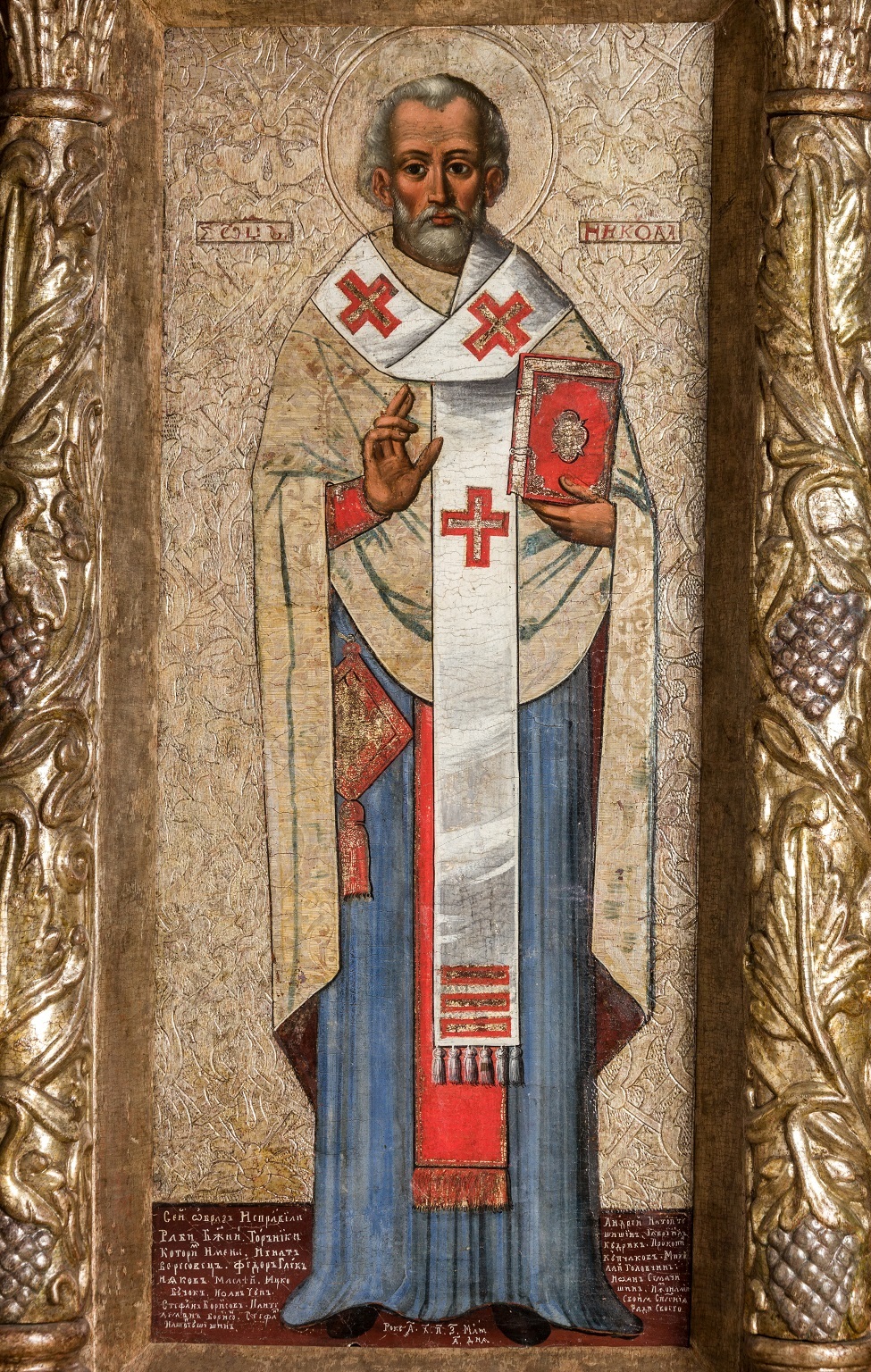
Name: icon of Saint Nicholas
Author: Ivan Rutkovych (?)
Date: 1687
Country: Ukraine
Technique/material: tempera and silver gilt on panel
The icon is part of the iconostasis exhibited in the museum "Stara Skvaryava iconostasis of the XVI-XVIII centuries"
Description:
This icon depicts Saint Nicholas, one of the most revered saints in the Ukrainian Church. His icons were most commonly placed in the iconostasis’s Sovereign tier, as we can see in the ensemble from Stara Skvaryava.
In iconography, Saint Nicholas is typically depicted as an older man with gray, short, slightly curly beard, short wavy hair, and a high forehead. According to his rank, Nicholas is portrayed in bishop’s vestments. In the icon from Stara Skvaryava, he is shown wearing a blue undercassock, a red epitrachelion (stole) peeking out from under a light-silver ornate brocade phelonion. Over the phelonion, he wears an episcopal omophorion (shoulder piece) decorated with red crosses embellished with gold. Near the right thigh of the saint, we can see a staff, which is an element of the liturgical vestments of the bishop (diamond-shaped cloth symbolizing the spiritual sword). On it, a six-winged seraphim is painted in gold on a red background.
Interestingly, Saint Nicholas in the icon is depicted frontally in full stature, which was characteristic of Ukrainian iconography in the 15th and 16th centuries. In contrast, from the beginning of the 17th century, saint in icons was more often depicted in half-length. Another detail that reflects the iconography of previous centuries is the absence of a mitre (bishop’s hat) on the head of Saint Nicholas. This detail became more common in the iconography of the saint from the 17th century onwards. The saint’s right hand is raised in blessing, and in the left hand, he holds a closed Gospel Book. There is a halo around his head. The background of the icon is richly decorated with carved and silvered ornamentation on a wooden base.
A very valuable piece of history related to the iconostasis is the extensive foundation text and date, carefully inscribed by the artist at the feet of the saint. From this text, we learn that the icon was created on May 1, 1687, and its founders were the “Servants of God, Horniky” (followed by the names and surnames of 13 men) “with their wives.” It is likely that “Horniky” refers to some delineation of residents from a particular district or settlement in Hlynsk, from where the iconostasis originates, possibly those who lived on Mount Harai.
The description was prepared by Roman Zilinko, art historian, icon painter