
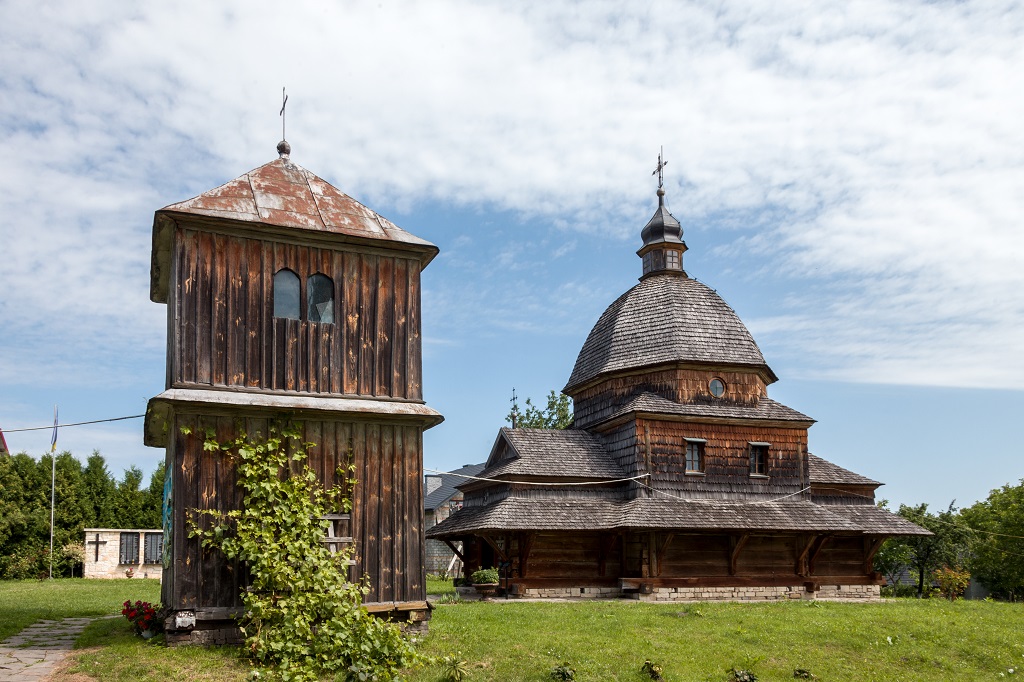
The church in Stara Skvaryava belongs to the widely spread Galician style of wooden sacred architecture in the vicinity of Lviv.
The church has a traditional three-part layout consisting of the narthex, nave, and sanctuary. It is crowned with a single dome above the nave. In the nave, on the south side, there are three windows (two in the nave wall and one higher up beneath the dome), as well as one window in the north wall of the nave. The church has only one entrance, which is on the west side. Adjacent to the church is a wooden bell tower, likely dating back to the 19th century.
According to research by Vasyl Slobodian, the church dates back to the year 1508 and was originally located in the neighbouring village of Hlynsk. It was relocated to Stara Skvaryava in 1715, replacing a previous church known since 1578. The construction date was discovered in a graffiti on the north wall of the church, making it one of the oldest wooden churches in Ukraine, despite later renovations, relocations, and alterations. It is likely that the iconostasis was also moved from Hlynsk along with the church.
Before discussing the iconostasis of the Church of St. Archangel Michael in Stara Skvaryava, it’s important to keep in mind that creating one integral of pre-altar partition, iconostasis, has always been a costly endeavour. The realization of such works often required the involvement of patrons, such as estate owners on whose territory the church was located, or individual members of the community, monasteries, or non-governmental organizations, including craft guilds, brotherhoods etc. To this day, only a few such objects executed at the same time, by a single master or workshop, have survived. In reality, the majority of iconostases were created over an extended period and were often assembled from icons and structures made by multiple artists at different times, and sometimes even from different locations.
The Stara Skvaryava iconostasis is indeed such. It was created in several stages, and individual icons and entire rows can be dated from the second half of the 16th century to the beginning of the 19th century. This is a special value of this monument because by examining this ensemble, we can trace a three-hundred-year evolution in the development of the Ukrainian iconostasis and its stylistic changes.
However, it’s also worth noting that the iconostasis did not reach us in its entirety in its original place. Two icons from the Deisis tier and the Crucifixion icon with accompanying figures (all dating from the mid to late 16th century) came to the collection of The Andrey Sheptytsky National Museum of Lviv in the first half of the 20th century. It is likely that during that time, these icons were removed from the iconostasis, possibly due to some intervention, and were located somewhere within the auxiliary premises of the church. It can be assumed that this happened when the tier of Sundays of Pentecost (beginning of the 19th century), located between the Sovereign and Deisis tiers, and the figured Crucifixion with Attendants (mid-18th century), which is now on the iconostasis, were being completed.
In this form, the iconostasis remained in the church until 1995 when, at the initiative of conservators Halyna and Levko Skop, it was transferred to the Lviv Museum of the History of Religion. Since then, the monument has been researched and conserved. One of the outcomes of this work was the publication in 2009 of an album authored by Halyna Skop-Druzyuk and Petro Skop dedicated to the Stara Skvaryava iconostasis. The iconostasis was also placed on display in the exhibition of the Lviv Museum of the History of Religion.
Later, after the conservation of the church in Stara Skvaryava and the opening of a branch of the Lviv Museum of the History ofReligion there, the iconostasis was returned to its original location in 2015.
The oldest part of iconostasis, dating back to the mid to late 16th century as determined by researchers, is the unique Deisis tier combined with the Feasts tier. Like most masters of that time, the author of this section of the iconostasis remains unknown, but researchers tentatively attribute it to the Przemyśl School of Icon Painting. What makes this tier exceptional is the central icon of Christ in Glory. Typically, in Ukrainian iconostases of the 15th and 16th centuries, such icons were placed in the Sovereign tier, but here, we have one of the two known cases where the Christ in Glory icon is positioned at the centre of the Deisis tier. Additionally, what is unique is the placement of the Last Supper icon at the centre of the Feast tier. This is the earliest instance of using this icon in the festive cycle of the iconostasis. Typically, the icon of the Image of Edessa was placed here. The Last Supper, with a few exceptions, only appeared in the feast tiers of Ukrainian iconostases beginning in the early 17th century.
The next in chronological order within the iconostasis is the Sovereign tier, but it is not uniform either. The oldest elements in this tier are the portal of the Beautiful Gates and the Gates themselves. The portal is dated to 1645, and the authorship of the icons depicted on the portal belongs to a workshop that operated in the mid-17th century in the north-western part of modern Lviv Region and in the bordering areas, which now belong to Poland. The Gates themselves are slightly later in origin and may have come from a different ensemble, and it appears they were later adapted to the door frames. Additionally, the figure of Jesse in the lower part of the Gates is poorly preserved and was added to the existing carved composition, indicating a later intervention.
The Deacon’s Doors with the depiction of Archangel Michael are dated to 1677. Some researchers attribute them to the legacy of the well-known artist from Zhovkva, Ivan Rutkovych (died in 1703), while others only mention the artistic environment but do not confirm his authorship. Icons of the Sovereign tier and the predella icons of the Saviour and the Virgin Mary are also associated with Ivan Rutkovych and his artistic circle. Ivan Rutkovych typically signed his iconostases and even individual icons, but he did not leave his signature here, raising questions about authorship. However, the painting style supports this hypothesis.
The predella icon “Christ Giving the Keys to St Peter” is dated to 1685, and another date, 1687, is found in the foundation text on the ground of the icon of St. Nicholas. This allows us to discuss the execution of all other icons in this row within these timeframes: the Virgin Mary (with the predella “Moses and the Burning Bush”), Savour, and the Synaxis of the Archangel Michael. Interestingly, the last icon, most likely in the mid-18th century, had an entire altar added with a cartouche depicting the Nativity of Christ at the top. It is probable that the Crucifixion with Attendants at the top of the iconostasis also dates from the same period. It’s worth noting that similar compositions were characteristic of Ivan Rutkovych and his school. Zhovkva artists used them in their iconostases even until the mid-18th century, and this Crucifixion serves as confirmation of that.
The most recent change in the iconostasis is the inclusion of the tier of Sundays of Pentecost. Unlike other icons in the iconostasis, this cycle is attributed to a master from the early 19th century with rather modest talent. However, it serves as an important testament to the continuation of local iconographic traditions, even though it reflects a certain decline in their professional level. The Sunday of Pentecost Row in the iconostasis was introduced, or rather, became more widespread in the circle of Zhovkva artists in the second half of the 17th century. It essentially remained a local innovation and was rarely encountered beyond Galicia. The fact that it found its place in the Stara Skvaryava iconostasis, albeit much later than in most cases, confirms the longevity of the local iconographic tradition.