
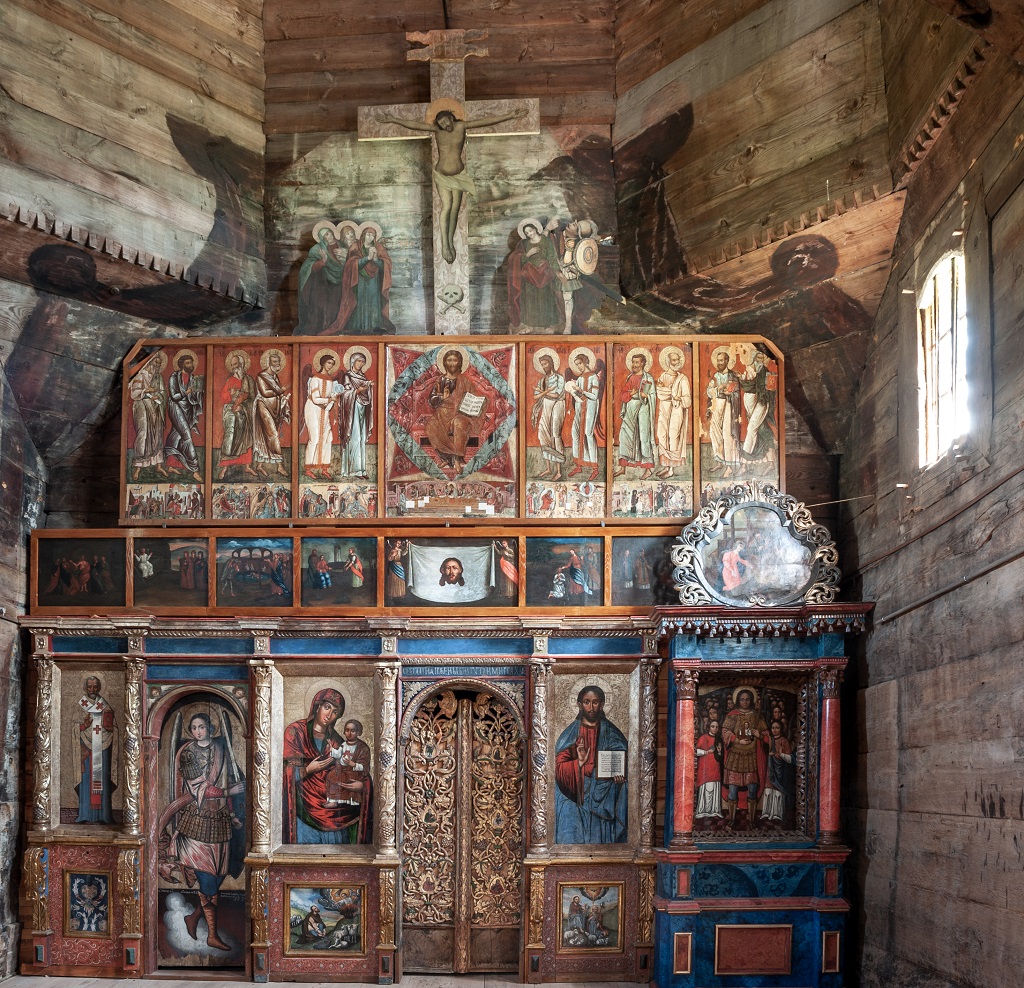
The iconostasis in Ukrainian churches has its own history of development and was formed over many centuries.
When Kyiv Rus adopted Christianity in 988, prototypes of today’s iconostases had already existed in the Byzantine Empire for hundreds of years, for example, altar partitions called ‘templons’ (a stone or wooden beam placed on columns or pillars between the sanctuary and the main area of the church). Such a partition both separated the sacred space and served as an entrance to it for the clergy.
Accordingly, proto-iconostases came to the first churches on our lands in the form they acquired in Byzantium. We get modest information about the partitions of that time mainly from the materials of archaeological excavations, individual preserved icons, and chronicle and historical references. And based on this meager information, we can say that the iconostasis in the Ukrainian churches of the medieval period consisted of a beam (properly a templon) on which the icons were placed, and columns on which the beam rested. Between these columns, the most revered icons were also placed, along with entrances to the sanctuary.
Towards the end of the 14th century, Ukrainian iconostases consisted of two rows. The lower tier was called the “Namisnyi” (Local) or Sovereign, where the most revered icons were placed, those that were held in the highest regard. These included icons of the Virgin Mary, the Saviour (Jesus Christ), the patron saint of the church, often an icon of St. Nicholas, or another specially venerated saint or holidays of the liturgical year. There were also at least two passages to the sanctuary in the Sovereign tier: one in the centre and one on the left. The central entrance (which would later house the Beautiful Gates or Holy Doors) was used exclusively for liturgical purposes, through which the priests entered during the Service. The left entrance (later to be the Deacon’s Doors) served for entering during services, as well as for practical use by the church servants and workers. In larger churches, there could be more of these side entrances.
The second row, located above the Sovereign tier, was composed of selected icons. Typically, in the Ukrainian tradition, at the centre of this tier, there was an icon of the Saviour, surrounded by the Virgin Mary and John the Baptist, both in prayerful postures, addressing him. In Greek, this subject is called “Deisis”, which means “Prayer”. In an extended version, this composition was enriched with icons of individual saints, who, like the Virgin Mary and John, were turned toward Christ. The number of saints could vary and depended on the size of the partition, but they all symmetrically appeared to be approaching the centre - towards Christ. Due to the composition’s name, the entire second tier, and often the entire iconostasis in Ukraine, was called “Deisis” (or adapted to Ukrainian pronunciation –“Deisus”). At the top, the partition was crowned with an icon of the Crucifixion.
Later, in the 15th-16th centuries, icons of selected saints from the liturgical calendar began to be placed between the Sovereign tier and the Deisis tier. Initially, the number of these saints was arbitrary, but with the establishment of the tradition of celebrating the twelve great feasts, it was standardized to this number. At the centre of such a row, appropriately called the Feasts tier, there was an Icon of the Image of Edessa or Mandylion.
Around the time when the number of feasts became standardized, the Deisis tier also underwent certain changes. From a row of icons of selected saints, it is transformed into the tier of the Twelve Apostles, while the central composition with Christ, Mary, and John the Baptist remained in its place. In other words, the Deisis (Prayer) tier evolved into the Apostolic Prayer tier, or as it is still commonly referred to, the Apostolic tier. It was around this time that the Beautiful Gates appeared in the iconostasis, they were placed in the central entrance of the altar partition (usually depicting the four evangelists and the Annunciation scene on the doors). The Deacon’s Doors on the side entrances only emerged in the late 16th - early 17th century, with depictions of either saints-deacons, archangels, or high priests on them.
At the end of the 16th century, the last significant change in the composition of the Ukrainian iconostasis occurred, which spread across most of the territory of the Metropolis of Kyiv (Ukrainian and Belarusian churches) - the Prophets tier. It was located at the top above the Deisis tier. Thus, the traditional Ukrainian iconostasis consisted of four tiers: Sovereign, Feasts, Deisis, Prophets, and was crowned with the icon of the Crucifixion.
Other changes in the iconostasis, the number of its rows, cycles, and themes, would occur in local centres over the next centuries and rarely persist for extended periods, and they would never spread across the entire territory of Ukraine. The only other significant influence on the appearance of Ukrainian iconostases that characterized them as a shared tradition would be the carved icon frames. Starting from the early 17th century, under the influence of European art and architecture, carving and architectural elements would increasingly find their way into our altar partitions. These elements would resonate with the facades of contemporary buildings, window and door openings. The stylistic choices would change in accordance with the prevailing styles and eras: Renaissance, Mannerism, Baroque, Rococo, and others. From that time onward, all icons in iconostases would be placed in carved and decorated frames, horizontal tiers would be articulated with cornices, and the tops of iconostases would be adorned with icons in carved cartouches.